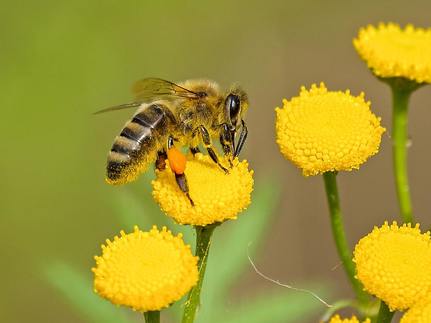
Bees produce honey to use for their food. After sucking nectar from flowers, bees take the nectar back to the hive where workers divide it between the young bees and the honeycomb, where it's stored. In the process of removing nectar, bees do the very important job of pollinating plants. Bees dehydrate the nectar over time and then seal the honeycomb with wax, saving the honey as their food supply. Making honey takes considerable effort. Because bees produce honey for their own use, vegans feel it's wrong to take it from them.
Removing honey from the hives requires the beekeeper to “relocate” some of the bees, smoking them out of the hive, which damages or even kills some of the bees in the process. Beekeepers can also harm the hive in other ways, such as by replacing their honey with high-fructose corn syrup or killing off the entire colony before winter because it’s less expensive to replace them in the spring than to keep them through the winter. Bees are also mangled when beekeepers remove the honeycomb to collect honey, thus the FDA acceptance of a certain number of bee parts (wings, legs, etc.) in commercial honey production.
Vegans consciously try not to hurt any living creature, from humans down to insects, including bees.
In conventional beekeeping, honeybees are specifically bred to increase productivity. Already endangered, this selective breeding narrows the population gene pool and increases susceptibility to disease and large-scale die-offs.
Queen bees often have their wings clipped by beekeepers to prevent them from leaving the hive to produce a new colony elsewhere, which would decrease productivity and lessen profit. They are also often artificially inseminated which is a stressful process both for the queens and for the male bees from whom the semen is extracted.
Finally, world bee populations are declining, in great part due to human intervention of one kind or another, resulting in not having enough bees to pollinate our crops. In China, humans must now do the arduous work of hand pollinating crops because there are simply not enough bees to do the job. Loss of bee populations is having devastating consequences for world food production.
Basically, caring for bees is caring about our future and the future of food. Life without bees and their critically important place in the food chain is a very frightening prospect.
Note: Some of the above information was modified, cut, and pasted from The American Vegan Society website.
Removing honey from the hives requires the beekeeper to “relocate” some of the bees, smoking them out of the hive, which damages or even kills some of the bees in the process. Beekeepers can also harm the hive in other ways, such as by replacing their honey with high-fructose corn syrup or killing off the entire colony before winter because it’s less expensive to replace them in the spring than to keep them through the winter. Bees are also mangled when beekeepers remove the honeycomb to collect honey, thus the FDA acceptance of a certain number of bee parts (wings, legs, etc.) in commercial honey production.
Vegans consciously try not to hurt any living creature, from humans down to insects, including bees.
In conventional beekeeping, honeybees are specifically bred to increase productivity. Already endangered, this selective breeding narrows the population gene pool and increases susceptibility to disease and large-scale die-offs.
Queen bees often have their wings clipped by beekeepers to prevent them from leaving the hive to produce a new colony elsewhere, which would decrease productivity and lessen profit. They are also often artificially inseminated which is a stressful process both for the queens and for the male bees from whom the semen is extracted.
Finally, world bee populations are declining, in great part due to human intervention of one kind or another, resulting in not having enough bees to pollinate our crops. In China, humans must now do the arduous work of hand pollinating crops because there are simply not enough bees to do the job. Loss of bee populations is having devastating consequences for world food production.
Basically, caring for bees is caring about our future and the future of food. Life without bees and their critically important place in the food chain is a very frightening prospect.
Note: Some of the above information was modified, cut, and pasted from The American Vegan Society website.